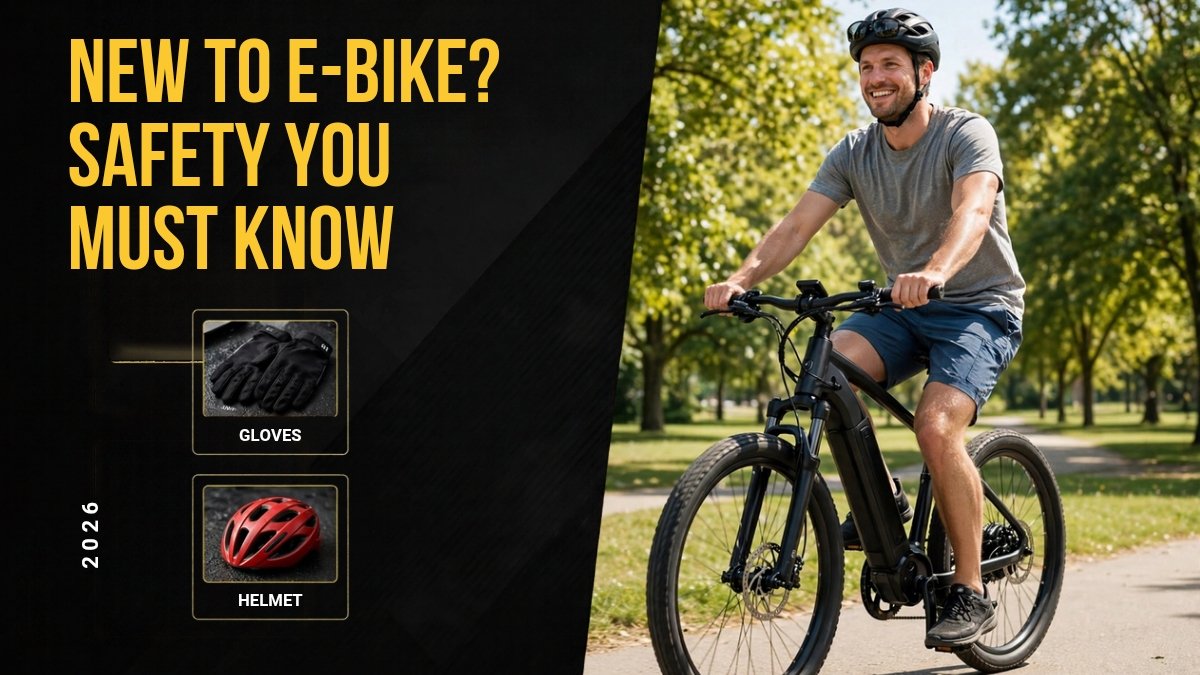
An e-bike looks like a normal bicycle, but it does not ride like one.
It is heavier. It is faster. And its power comes instantly.
That is why many beginners make mistakes on their first ride. Power kicks in suddenly at an intersection, brakes take longer to stop, and the bike feels heavy while turning.
If you learn 10 simple safety rules from day one, you will ride with full control and confidence.
Here is your complete beginner safety guide.
Quick Safety Blueprint
| Focus Area | What To Do | Why It Matters |
| Head Safety | Wear NTA 8776 or MIPS helmet | Protects brain at 20-28 mph speed |
| Power Control | Always start in Eco / Level 1 | Stops sudden jump from standstill |
| Braking | Start braking early, use both brakes | Heavy bike needs more distance to stop |
| Pre-Ride Check | 60-second ABCDE check | Catches loose parts, low tyre, battery issue |
| Speed Control | Match speed to surroundings | Gives you reaction time in crowd |
| Visibility | Lights ON + bright clothes | Drivers see you from far |
| Mounting | Hold both brakes while getting on | Bike does not roll or jump |
| Road Rules | Follow traffic, give signals | Prevents collision with cars |
| Battery Care | Use original charger only | Avoids fire and battery damage |
| Defensive Riding | Watch for car doors & right turns | Avoids most common accidents |
10 Safety Rules For Beginners – In Detail
1. Wear A Speed-Certified Helmet, Not A Normal Cap
Normal cycle helmets are made for slow falls. E-bikes go 32 to 45 km/h. A fall at that speed is very serious.
Buy a helmet with NTA 8776 certification – this is made specially for speed e-bikes – or a helmet with MIPS technology. MIPS protects your brain from side impacts.
How to wear it correctly: Helmet should sit level on forehead, 2 finger-widths above eyebrows. Side straps should make a ‘V’ under your ears. If helmet moves when you shake your head, it is loose.
2. Always Start In Lowest Power Mode
This is the No.1 mistake beginners make.
If you start in Turbo mode or touch the throttle by mistake while standing, the bike will jump forward suddenly.
- Rule: Always start in Eco / Level 1. Once you are moving and balanced, then slowly increase power.
At a red light, keep your hand away from the throttle. Hold both brake levers. Most e-bikes cut motor power automatically when brakes are pressed. This is your safety switch.
3. Learn Braking – E-Bike Takes Longer To Stop
Normal cycle weight is 12-15 kg. E-bike weight is 20-35 kg. More weight + more speed = more stopping distance.
- Brake Early: Start braking much earlier than you do on a normal cycle.
- Use Both Brakes: Press front and rear together, equally. Only front = you can flip over. Only rear = tyre will skid.
- Practice Hard Braking: In an empty parking lot, practice sudden stops from 20 km/h. So in real traffic, your hands already know what to do.
4. Do A 60-Second Pre-Ride Check – ABCDE
Before every ride, check these 5 things. It takes only 1 minute.
- A – Air: Tyre pressure should match PSI written on tyre side. Low pressure = puncture + less range.
- B – Brakes: Press both levers hard. They should feel tight, not loose.
- C – Chain: Check chain is not dry, rusty, or loose.
- D – Display & Cables: Check display wire and motor plug are tight.
- E – Battery: Battery must be locked properly. It should not move or shake.
If any one thing feels wrong, do not ride. Fix it first.
5. Do Not Ride At Full Speed Everywhere
Just because your e-bike can go 45 km/h, does not mean you should ride 45 km/h everywhere.
In crowded market, near school, on footpath, near pedestrians – slow down to 15-20 km/h.
Slow speed gives you 2 seconds extra reaction time. Those 2 seconds can save you from a car door opening suddenly or a child running on road.
6. Mount And Dismount Safely
E-bike is top-heavy because of motor and battery. Many people fall while just getting on the bike.
- Correct way: Stand beside bike, hold both brakes tight so wheels cannot move, then step over the frame. Never put your foot on pedal and swing your leg while holding throttle.
- Getting off: Hold brakes, then step down.
7. Be Visible – Drivers Misjudge E-Bike Speed
Car drivers think a cycle is slow. They do not expect you to come at 35 km/h. That is why they turn in front of you.
To stay visible:
- Keep front and rear lights ON even in daytime
- Wear bright / reflective jacket
- Use bell or horn on blind corners
If you ride at night, reflective vest is a must. Dark clothes at night = invisible.
8. Follow Traffic Rules Like A Vehicle
E-bike is legally a vehicle in most cities. You must follow same rules as cars.
- Ride in same direction as traffic, never opposite
- Stop fully at red light and stop sign
- Give hand signal before turning
- Do not jump between footpath and road suddenly
If you ride unpredictably, drivers cannot guess where you will go. That causes accidents.
9. Charge And Store Battery Safely
Battery is the most expensive and most dangerous part.
- Always use original charger. Cheap charger can cause fire.
- Charge on hard floor, away from bed, sofa, curtains. Never charge on carpet.
- Never leave charging battery overnight unattended.
- Store battery indoors at 15°C to 25°C. Do not keep in direct sun or in cold garage.
If battery is swollen, smells bad, or gets very hot while charging – stop using it immediately.
10. Ride Defensively – Never Assume Driver Sees You
Even if you have right of way, never assume driver sees you.
Watch for 3 most common dangers:
- Right Hook: Car turns right across your path without seeing you. Always slow down at intersections.
- Dooring: Door opens from parked car. Keep 1 meter gap from parked cars.
- Slippery Surface: Wet leaves, gravel, painted road lines, and manhole covers become very slippery on a heavy e-bike. Slow down on them.
Always scan 50 meters ahead, not just in front of your wheel.
E-Bike Classes – Know Which One You Have
Before riding on public road, know your bike class:
- Class 1: Pedal-assist only, no throttle, motor stops at 20 mph / 32 km/h. Allowed on most bike paths.
- Class 2: Has throttle, can go up to 20 mph / 32 km/h without pedalling.
- Class 3: Pedal-assist only, no throttle, motor stops at 28 mph / 45 km/h. Often not allowed on walking trails.
Check your city law. Some cities do not allow Class 3 on cycle tracks.
Essential Gear For Fast Rides
Beyond helmet, these 2 things save you from serious injury:
1. Eye Protection
At 30+ km/h, wind, dust, and insects hit your eyes. Wear clear or UV wraparound glasses.
2. Gloves
Full-finger gloves protect your palms if you fall, and give better grip when handlebar is wet with sweat or rain.
Beginner Practice Routine – Do This Before Going Into Traffic
Do not go straight into heavy morning traffic on your first day.
Day 1 – Empty Parking Lot (30 minutes)
Practice starting in Eco mode, sudden braking, tight U-turns, and slow-speed balance.
Day 2 – Weekend Dry Run
Ride your daily office route on a quiet Sunday morning. You will find potholes, tricky intersections, and bad roads without traffic pressure.
After 2 days practice, you will be ready for weekday traffic.
Final Checklist Before Every Ride
- Helmet is tight?
- Battery is locked?
- Tyre pressure is okay?
- Both brakes are tight?
- Lights are ON?
- Power is on Eco / Level 1?
If all 6 are yes, you are ready to ride.
Frequently Asked Questions (FAQs)
Is riding an e-bike really different from a normal bicycle?
Yes, very different. An e-bike is heavier and faster, and power comes instantly. On a normal cycle, if you stop pedalling, cycle slows down. On an e-bike, motor keeps pushing. So you need more careful braking and power control.
What is the most important safety gear for an e-bike beginner?
Helmet is No.1. Because e-bikes go faster and are heavier, a normal cap is not enough. Buy an NTA 8776 or MIPS helmet. After that, gloves and eye protection.
How can a beginner stay safe in traffic on an e-bike?
Use low power mode in crowded areas. Practice hard braking in an empty lot before going into traffic. Keep 1 meter gap from parked cars, and never ride at full speed in crowded streets.
Should I use throttle in traffic?
No. In traffic, use pedal-assist only, in Eco mode. Throttle can jump suddenly if you touch it by mistake. Keep throttle only for open roads.
What to do if e-bike power kicks suddenly?
Immediately hold both brakes. Brakes cut motor power in most e-bikes. Then switch power to Eco / Level 0. Do not try to control it with your legs.
Final Verdict
If you tell me your city and your daily route – busy traffic or open road – I will tell you which safety settings and which helmet will be best for you.
1 thought on “10 Crucial Safety Rules Every Beginner E-Bike Rider Must Know”