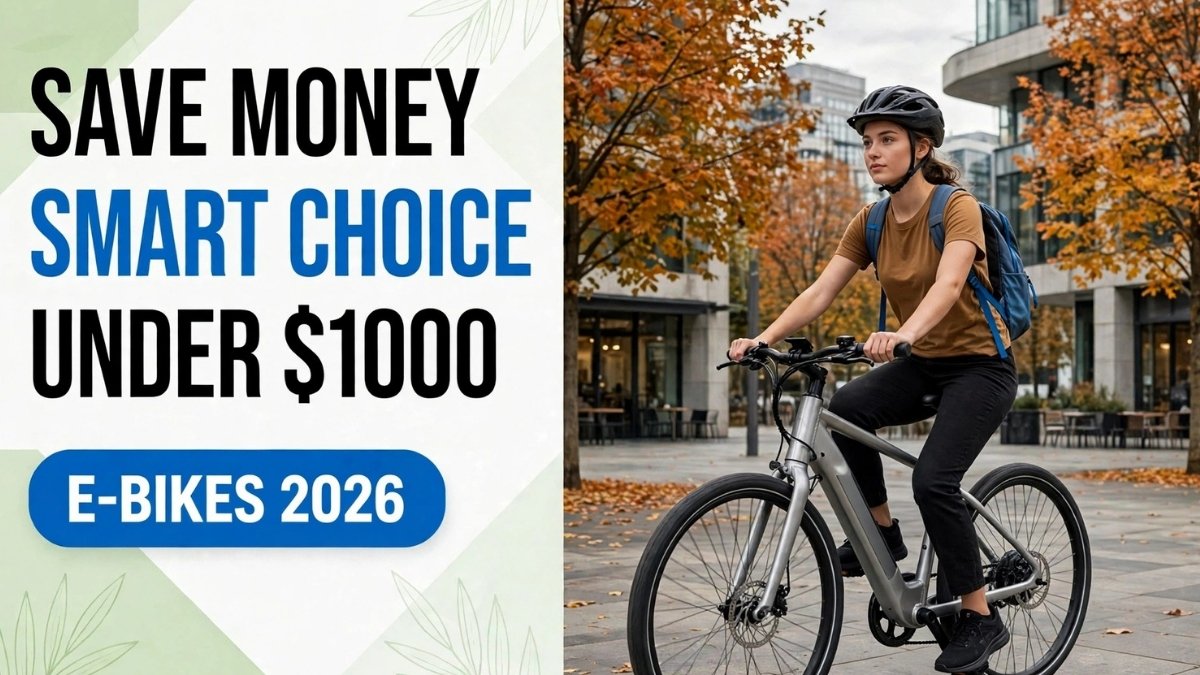
Do you want to buy an e-bike for daily office, college, or work, but your budget is under $1,000?
Good news: In 2026, you do not need to spend $2,000 or $3,000 to get a good e-bike.
Budget e-bikes are no longer weak toys. Now many brands under $1,000 give you a decent motor, certified battery, and good brakes for daily city use.
But there is a catch. In this price, some bikes are very good, and some are total waste of money. If you buy the wrong one, you will pay again and again for repair.
In this guide, I will explain in simple words what you get under $1,000, what you do not get, which type is best for you, and what to check before buying.
Quick Comparison: Budget vs Expensive E-Bike
| Feature | Budget E-Bike (Under $1,000) | Mid-Range E-Bike ($2,000+) |
| Motor | 350W to 500W Hub Motor | Mid-Drive Motor with Torque Sensor |
| Battery | 374Wh to 500Wh | 650Wh to 1000Wh+ |
| Real Range | 30 to 55 km | 80 to 130 km |
| Brakes | Mechanical Disc / Basic Hydraulic | Hydraulic Disc, Big Rotor |
| Sensor | Cadence Sensor (On/Off) | Torque Sensor (Smooth) |
| Gears | Single Speed or 7-8 Speed | Internal Gear Hub / Belt Drive |
| Safety | UL 2271 / UL 2849 (Must Check) | UL 2849 + Smart BMS |
In simple words: Budget bike will take you to work daily. Expensive bike will take you further, smoother, and with less maintenance.
What To Expect Under $1,000? Real Truth
Do not believe the box that says “80 km range”. In real city use, range is less.
1. Motor Power
Most budget bikes have 350W to 500W rear hub motor. On flat road, it easily goes up to 32 km/h. On a small hill, it works fine. But on a long steep hill with full load, the motor gets hot and slows down a little. This is normal in this price.
2. Real Battery Range
A 374Wh to 500Wh battery in real use gives:
- Eco mode (low assist): 45 to 55 km
- Normal mode: 30 to 40 km
- Full throttle / high assist: 20 to 30 km
If your daily up-down is 20 to 30 km, a budget e-bike is enough. If your daily ride is 50 km+, you need a bigger battery.
3. Battery Safety Is Must
In this price, many local brands sell uncertified batteries. Never buy those.
A good budget bike must have UL 2271 (for battery) or UL 2849 (for full system). If there is no certification, do not buy it, even if it is very cheap. A cheap battery can catch fire.
Golden Rule For Budget Bikes:
Always choose hydraulic disc brakes over mechanical disc brakes if possible. Hydraulic brakes need less hand force, stop faster in rain, and adjust themselves when pads wear out. For a heavy e-bike in city traffic, brakes are more important than speed.
4 Types Of Budget E-Bikes: Which One Is For You?
Do not buy by brand name. Buy by your need. There are 4 types under $1,000:
1. Lightweight Folding E-Bike
Small 20-inch wheels, folds in half.
- Best for: People who take train / bus + bike, live in flat, have small storage
- Weight: Under 22 kg
- Problem: Small wheels feel less stable on rough road
If you have to carry the bike upstairs daily, this is the best option.
2. High-Torque Folding E-Bike
Same folding frame but stronger motor and strong rear rack.
- Best for: Carrying heavy bag, grocery, going on hills
- Load Capacity: Rear rack up to 60 kg
- Problem: A little heavier than normal folder
Best for delivery riders and people who carry a lot of weight daily.
3. Step-Through City Cruiser
Normal big wheels 27.5-inch or 700c, low frame, you can easily step over it.
- Best for: Daily office / college, long comfortable ride, ladies and older riders
- Comfort: Very good, upright seating, less back pain
- Problem: Cannot fold, needs more parking space
If you ride 15 to 20 km daily on normal city road, this is the most comfortable option.
4. Ultra-Budget Basic E-Bike
Simplest model. 350W motor, mechanical brakes, cadence sensor.
- Best for: Very tight budget, flat area, short ride 5 to 10 km
- Price: $500 to $700
- Problem: Basic brakes, basic comfort
If your budget is very low and your area is flat, this is okay for starting. Do not expect premium feel from it.
Cadence Sensor vs Torque Sensor: What Is The Difference?
This is the most confusing part for new buyers. Let me explain simply:
Cadence Sensor (Comes in Budget Bikes)
It only checks if you are pedaling or not. If you pedal, motor gives full power of that level. If you stop, motor stops. It feels like an On/Off switch. A little jerky, but easy to use.
Torque Sensor (Comes in Expensive Bikes)
It checks how hard you are pushing the pedal. If you push lightly, motor gives light power. If you push hard on a hill, motor gives more power. It feels very natural, like a normal cycle, and saves battery.
Which One To Take?
If your area is flat and you just want to go to work, cadence sensor is enough. If your area has many hills, try to find a torque sensor bike, even if you have to pay $100 to $200 extra.
5 Things You Must Check Before Buying A Budget E-Bike
Do not buy in a hurry. Check these 5 things in the shop:
- Safety Certification: Ask for UL 2271 or UL 2849 certificate. Check the QR code on the battery. If shop cannot show it, walk away.
- Battery Is Removable Or Not?: Battery must be removable. So you can take only the battery inside your office to charge, and leave the bike locked outside.
- Lights, Fenders, And Rack: Good commuter bike should have headlight and taillight connected to main battery, full fenders for rain, and a rear rack for bag. If these are not included, you will spend $50 to $80 extra later.
- Brake Test With Weight: Sit on the bike and test brakes. Mechanical brakes need more hand force. If brakes feel loose, ask shop to adjust before buying.
- Spare Parts And Warranty: Ask: “Battery warranty kitni hai? Motor warranty kitni hai? Brake pads mil jayenge?” A good brand gives at least 1 year warranty on battery and motor.
How To Take Care Of A Budget E-Bike Battery?
Budget batteries are small. If you take care, they will last 3 years. If you do not, they will die in 1 year.
1. Do not charge in extreme heat or cold
Never charge in direct sunlight, inside a hot car, or in below 0-degree. Best temperature is 15 to 30 degrees.
2. Do not leave it full or empty for long time
If you are not using the bike for 2 weeks, keep battery at 50% to 70%. Never leave it at 0% or 100% for weeks.
3. Do not charge overnight daily
Unplug once full. Overcharging kills budget batteries faster.
4. Clean chain every 100 miles
If your bike has a chain (not belt), clean and oil it every 150 to 200 km. A dry chain wastes battery and makes noise.
5. Check tyre pressure every week
Low tyre pressure = less range + more chance of puncture. Keep tyre pressure as written on the tyre side.
Pros and Cons of Budget E-Bikes Under $1,000
Pros
- Very low price, easy to start
- No petrol cost, charging cost is almost zero
- Good for 20 to 30 km daily ride
- Easy to park, no parking fee
- Folding models fit in flat and car
Cons
- Range is limited, not for long tours
- Motor gets hot on long hills
- Brakes and parts are basic, need more maintenance
- Ride feel is not as smooth as expensive bikes
- Resale value is low
Frequently Asked Questions (FAQs)
Are budget e-bikes under $1,000 actually reliable?
Yes, if you buy a certified brand. A good budget e-bike can easily run daily for office use for 2 to 3 years. You just need to check battery certification, brakes, and motor quality before buying. Cheap uncertified bikes are not reliable.
What should I check before buying a cheap e-bike?
Check 3 things first: 1) UL 2271 or UL 2849 certification, 2) Brakes – hydraulic is better than mechanical, 3) Battery cells and warranty. If these 3 are good, the bike will not trouble you much.
Can a budget e-bike handle daily commuting?
Yes. If your daily ride is 20 to 30 km on flat or normal city roads, a budget e-bike is perfect. It will save your petrol money daily. You just need to charge it properly and clean the chain every week.
How long does a budget e-bike battery last?
A good budget battery lasts 2 to 3 years or 700 to 800 full charges. If you do not charge it overnight daily and keep it at 50% to 70% when not in use, it will last longer.
Should I buy a folding e-bike or a normal city e-bike?
If you live in a flat, take a train daily, or have less storage space, buy a folding e-bike. If you have parking space and ride 15 km+ daily, buy a step-through city cruiser. It is more comfortable for long rides.
Final Verdict: Which Budget E-Bike Should You Buy?
If you are confused, use this simple rule:
- Daily ride less than 10 km, flat area, tight budget: Take Ultra-Budget Basic E-Bike
- Daily ride 10 to 20 km, need to carry in flat / train: Take Lightweight Folding E-Bike
- Daily ride 15 to 25 km, want comfort: Take Step-Through City Cruiser
- Carry heavy bag / grocery / hills: Take High-Torque Folding E-Bike
Do not buy the cheapest bike in the market. Buy the cheapest certified bike in the market. That one extra check will save you from fire risk and repair cost.
2 thoughts on “Best Budget E-Bikes Under $1,000 For Daily Commuting in 2026”