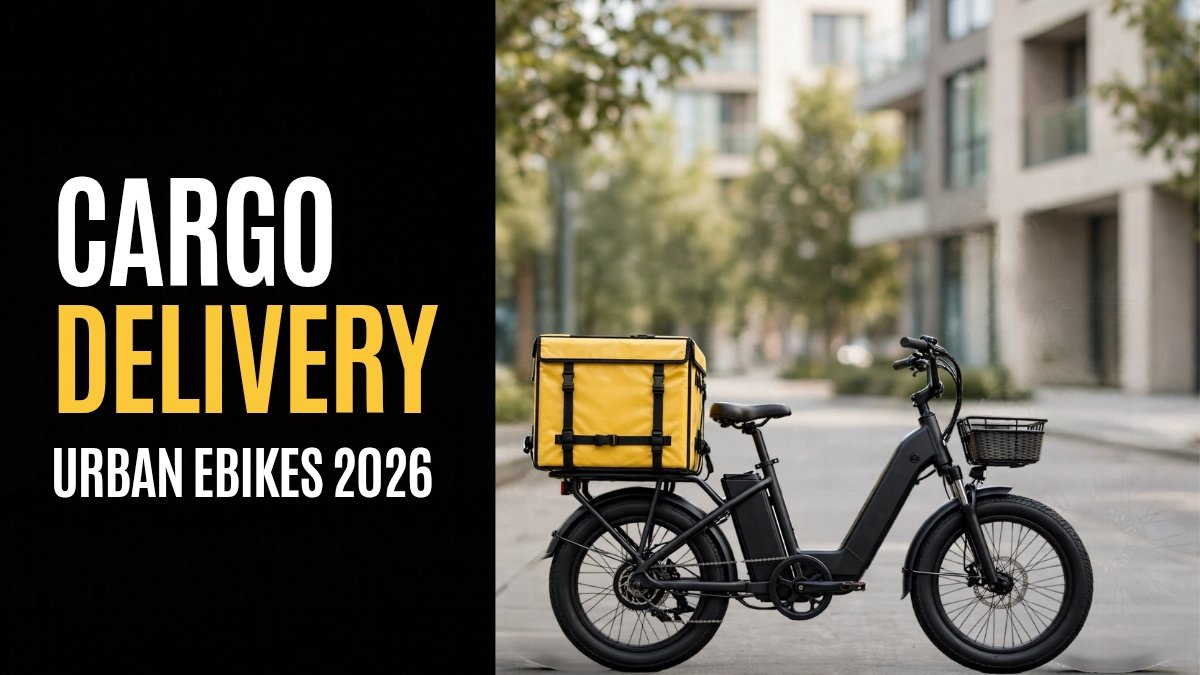
If you order something online today, there is a big chance the last part of your parcel journey is not done by a van, but by an e-cargo bike.
Big delivery vans are now getting stuck in traffic, paying parking fines, and facing bans in city centres because of pollution. Small and big companies both are shifting to e-cargo bikes for city deliveries.
In this article, I will explain in simple words how e-cargo bikes work, which type is best for which city, how much money businesses save, and can they really replace vans or not.
Quick Comparison: Delivery Van vs E-Cargo Bike
| Factor | Delivery Van | E-Cargo Bike |
| Traffic | Stuck in jam, cannot use cycle lane | Goes through cycle lane, bus lane, narrow street |
| Parking | Needs big space, double parking fine | Parks right in front of shop, no fine |
| Daily Fuel / Charging Cost | High – petrol / diesel + engine oil | Very low – 1 full charge costs less than 1 litre petrol |
| Maintenance | Engine, clutch, brakes, high cost | No engine, only brake pad, tyre, belt |
| Pollution | Smoke + noise | Zero smoke, almost no noise |
| City Rules | Congestion charge, LEZ ban | No congestion charge, allowed in LEZ |
In simple words: Van is good for long distance. E-cargo bike is best for last 2 to 5 km inside the city.
What Is An E-Cargo Bike? Not A Normal Cycle With Basket
Many people think e-cargo bike means a normal cycle with a basket in front. That is wrong.
Commercial e-cargo bikes are made specially for delivery work. They have a strong steel frame, powerful mid-drive motor, big battery, and a lockable cargo box.
They are divided into 4 types. Every type is for a different city and different work.
1. Two-Wheel Longjohn – For Narrow Streets
This has a long front part, and the cargo box is between the handlebar and front wheel. The load stays low, so balance is good.
- Best for: Old city areas, narrow streets, food delivery, small parcels
- Capacity: 80 to 120 kg
- Problem: Space is less than a trike
If you deliver in a city like Lahore, Karachi, Faisalabad old city, or any area with narrow gali, this is the best option.
2. Three-Wheel Trike – For Heavy Load And Stability
This has 2 wheels at back or front, with a big lockable box.
- Best for: Grocery, pharmacy, courier, 100 to 180 kg load
- Capacity: Up to 180 kg
- Problem: A little wide, needs a wide cycle lane
The biggest benefit is stability. Even when fully loaded, it does not fall when you stop. The rider can load and unload without holding the bike.
3. Four-Wheel Quadricycle – Mini Van On Cycle Lane
This looks like a small van. It has 4 wheels, covered cabin for rider, and a big enclosed cargo box up to 2,000 litres.
- Best for: High-volume parcel routes, suburban areas, big e-commerce
- Capacity: Up to 270 kg (600 lbs)
- Problem: Needs wide road, cannot go in very narrow gali
This is best for companies like Daraz, TCS, Leopards, Amazon type work where one rider has to deliver 80 to 100 parcels in one shift.
4. Trailer System – Bike + Trailer
A normal e-cargo bike pulls a separate motorized trailer.
- Best for: Big but light parcels, like clothes, shoes, boxes
- Capacity: Flexible, you can add or remove trailer
- Problem: Turning and reversing needs experienced rider
This is good for businesses that sometimes have small load, sometimes big load. You do not need to buy a big vehicle for all days.
How Does A Modern Delivery Hub Work? Step By Step
A good e-cargo system does not work alone. It works with a small hub inside the city.
Here is the full process used by big companies in 2026:
Step 1: Morning Bulk Drop
A big truck brings all parcels from the main warehouse to a small micro-hub inside the city early in the morning, before traffic starts. This micro-hub can be a small shop, container, or old parking area.
Step 2: Route Sorting
Software sorts parcels area-wise. Each rider gets parcels for only one small area, within 3 to 8 km radius. This saves time.
Step 3: Battery Swap, Not Charging
Riders do not wait for charging. They just pick a pre-charged battery from the hub, put it in the bike, and leave. Empty battery stays on charge. This is called hot-swap. One bike can work 2 shifts in a day.
Step 4: Last-Mile Delivery
Rider goes through cycle lanes and narrow streets, delivers 40 to 70 parcels, and comes back to hub.
Step 5: Live Tracking
Every bike has IoT sensors. The manager on computer can see battery %, motor temperature, brake wear, speed, and whether cargo box is locked or open. If any problem comes, manager gets alert before the bike breaks down on road.
This system is why e-cargo bikes are now faster than vans inside the city.
What Should Businesses Check Before Buying? 3 Important Things
If you are a shop owner or starting a delivery business, do not buy only by looking at price.
1. Motor Torque Must Be 100Nm+
For heavy load and hills, a normal 50Nm motor will get hot and die fast. For commercial use, always take a mid-drive motor with 100Nm or more torque.
2. Use Belt Drive, Not Chain
Normal chains need oil, get loose, and break under heavy load. New commercial bikes use carbon belt drive with internal gear hub. No oil, no chain drop, no dirty clothes. Maintenance is 3 times less than chain.
3. Battery Must Be Swappable
If battery is fixed inside the bike, your rider will wait 4 hours for charging. If battery is swappable, your bike never stops. For business, swappable battery is a must.
Which E-Cargo Bike Is Best For Which Area?
- Narrow historic city / old bazaar: Take Two-Wheel Longjohn. Slim body, easy to turn.
- Normal city / grocery / food delivery: Take Three-Wheel Trike. Stable, 150 kg load, easy loading.
- Suburb / high-volume parcel / long route: Take Four-Wheel Quadricycle. Big box, no need to come back to hub again and again.
- Hilly area: Take Mid-Drive motor with automatic gear. It will climb with full load without heating.
- Truck + Bike combined work: Take Modular container system. Same box goes from truck to bike without re-sorting parcels.
How Much Money Can A Business Save?
This is the question every shop owner asks.
A normal delivery van in Pakistan / India costs per month:
- Petrol: 60,000 to 90,000
- Driver salary + parking fines + maintenance: 30,000 to 40,000
- Total: Around 1,00,000+
An e-cargo bike per month:
- Charging: 3,000 to 5,000
- Rider salary + small maintenance: 30,000 to 35,000
- Total: Around 35,000 to 40,000
That means a business can save 50% to 60% on delivery cost. And there is no parking fine because the bike parks in front of the shop.
For a small shop with 2 bikes, this saving is enough to pay the bike EMI.
Pros and Cons of E-Cargo Fleets
Pros
- 50% to 60% lower delivery cost
- No traffic jam, no parking fine
- Zero petrol, zero smoke
- Allowed in low-emission zones
- Can deliver in narrow streets where van cannot go
Cons
- Cannot carry very big items like fridge, washing machine
- Range is limited, best for 2 to 5 km radius
- Rain and extreme heat is hard for rider without cabin
- Initial price of good commercial bike is high
- Needs a micro-hub near delivery area
Frequently Asked Questions (FAQs)
Can e-cargo bikes really replace delivery vans?
For last-mile delivery inside the city, yes. A van is still needed to bring bulk parcels from warehouse to city hub. But from hub to customer home, e-cargo bike is faster and cheaper than van. For long highway delivery, van is still better.
How much can businesses save with e-cargo fleets?
On average, businesses save 50% to 60% on monthly delivery cost. Main saving is on fuel, parking fines, and maintenance. A small shop using 2 e-cargo bikes can save the cost of one van completely.
Are e-cargo bikes good for heavy packages?
Yes. A good commercial trike or quadricycle can easily carry 150 to 270 kg. Because of the mid-drive motor, the rider does not feel the full weight. It feels light even with full load, and the low centre of gravity makes it stable.
How many parcels can one e-cargo bike deliver in a day?
In a busy city area, one rider can deliver 40 to 70 parcels in one shift of 8 hours. If the hub is close and battery is swappable, the same bike can do 2 shifts with 2 riders.
What is the battery life of a commercial e-cargo bike?
A good lithium battery lasts 2 to 3 years in commercial daily use, or around 800 to 1000 full charges. If you use swappable batteries and do not charge to 100% every time, it will last longer.
Final Verdict
E-cargo bikes are not a future idea. They are already replacing vans for city deliveries in 2026.
If you run a small shop, pharmacy, bakery, or courier business, and your deliveries are within 5 to 8 km, an e-cargo bike will save you money from the first month.
Start with one trike, one swappable battery, and one small hub. If it works, add a second bike. Do not buy a big fleet on day one.
1 thought on “E-Cargo Bikes vs Delivery Vans: How E-Cargo Fleets Are Changing Last-Mile Delivery in 2026”