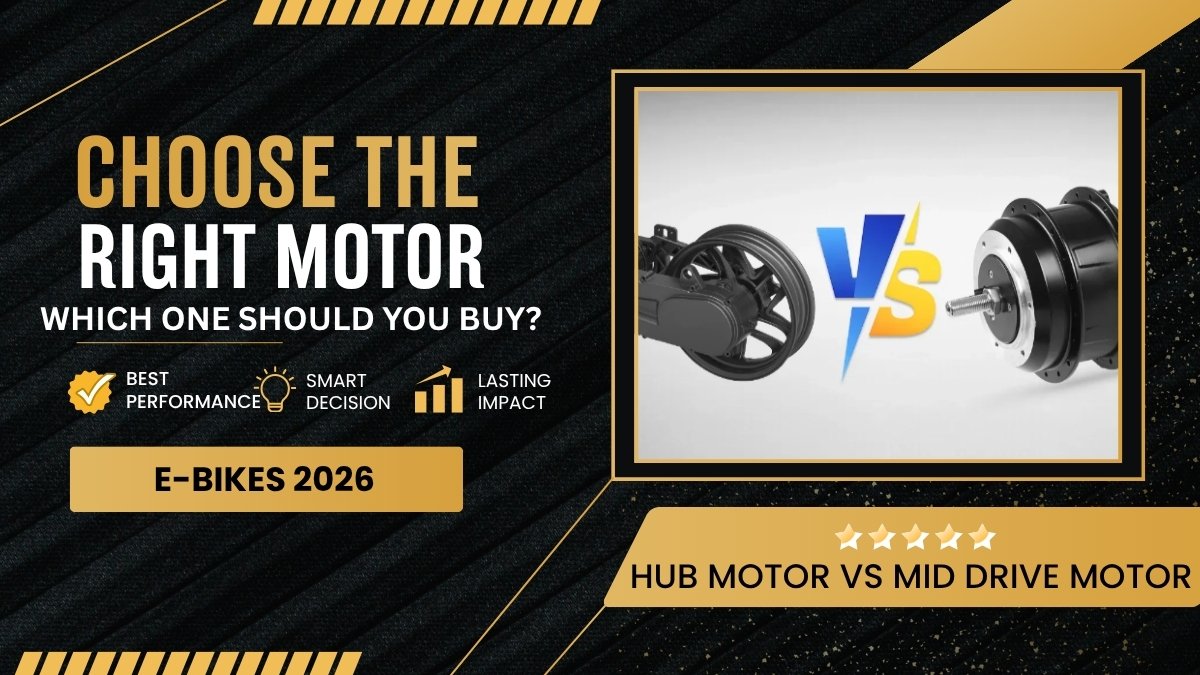
Choosing the right motor is the single most important decision when purchasing an electric bike. The motor dictates how power is delivered, how the bike handles, how efficient it is on hills, and how much long-term maintenance it will require. The two primary motor configurations dominant in the market today are hub motors (positioned in the center of the front or rear wheel) and mid-drive motors (positioned at the crank set between the pedals).
Both designs have distinct mechanical advantages, trade-offs, and ideal use cases. This comprehensive guide compares hub motors and mid-drive motors across performance, terrain adaptability, maintenance, cost, and riding feel to help you choose the best motor for your specific needs.
1. Core Comparison Matrix
| Technical Metric | Hub Motor (Rear/Front) | Mid-Drive Motor |
|---|---|---|
| Placement | Center of front or rear wheel hub | Integrated into frame at bottom bracket |
| Power Transfer | Directly rotates the wheel | Drives the chain/belt via bike gears |
| Hill Climbing Ability | Moderate (struggles on steep inclines) | Exceptional (uses bike’s gear ratios) |
| Weight Distribution | Heavy at wheels (rear/front heavy) | Low and centered (balanced handling) |
| Drivetrain Wear | Zero extra wear on chain/cassette | Higher wear on chain and rear cassette |
| Flat Tire Repair | Complex (wiring & heavy hub) | Standard (same as traditional bike) |
| Cost Range | Budget-friendly to Mid-range | Premium to High-end |
2. How They Work: Mechanical Differences
1. Hub Motors
Hub motors operate completely independently of your bicycle’s mechanical gear system. Encased inside the wheel hub, the motor pushes the wheel directly around its axle when power is applied.
Direct Drive vs. Geared Hubs
Direct drive hub motors have no moving parts inside other than bearings, making them nearly indestructible. Geared hub motors use internal planetary gears to spin the motor faster internally, delivering higher torque from a smaller, lighter casing.
Independent Propulsion
Because a hub motor drives the wheel directly, it operates regardless of what gear your chain is on. Even if your chain breaks or derailleur bends, a hub motor with a throttle can still propel you home.
2. Mid-Drive Motors
Mid-drive motors are located at the center of the bike frame, directly where the pedals and crank arms connect. Instead of powering the wheel directly, a mid-drive motor applies power directly to the front chainring.
Leveraging Bicycle Gears
The motor’s output passes through the bike’s chain and rear cassette cogs before reaching the rear wheel. This allows the motor to leverage the mechanical advantage of the bike’s gears in the exact same way human legs do.
Synergy with Human Power
By running through the mechanical gears, a 250W mid-drive motor can generate equal or greater climbing torque than a 750W hub motor while consuming significantly less electrical power.
3. Terrain Performance and Hill Climbing
The primary functional difference between the two configurations emerges on steep inclines and off-road trails.
1. Climbing Steep Hills
Mid-Drive Advantage
When approaching a steep mountain ascent, a rider with a mid-drive motor downshifts into a lower mechanical gear. This allows the motor to spin fast at its optimal RPM while multiplying torque output to the rear wheel. Mid-drives rarely overheat on long, steep climbs because the gears keep the motor operating within its efficient power band.
Hub Motor Limitation
Hub motors cannot leverage the bike’s gears. When climbing steep hills, a hub motor slows down alongside the wheel speed. As motor RPM drops under heavy electrical load, efficiency plummets, converting battery energy into excess heat rather than forward motion. Prolonged steep climbing on a hub motor can trigger thermal shutoffs.
2. Flat-Ground Cruising and Speed
On flat pavement, city streets, and smooth bike paths, a high-wattage rear hub motor delivers smooth, rapid acceleration with minimal noise. For flat urban commuting, hub motors offer responsive, powerful propulsion that rivals or exceeds mid-drives in straightforward speed delivery.
4. Riding Dynamics and Handling
Motor placement significantly impacts how a bicycle maneuvers, corners, and handles over obstacles.
1. Weight Distribution
Mid-Drive Balance
Mid-drive motors place heavy electrical weight (5 to 8 lbs) low on the frame, right between the rider’s feet. This creates a low center of gravity and a 50/50 front-to-rear weight balance. The bike feels agile, grounded, and natural—essential for technical mountain biking, sharp cornering, and jumping over trail obstacles.
Hub Motor Balance
Rear hub motors concentrate significant weight over the rear axle, making the tail end heavy. This can make the front wheel feel light and reduce traction when steering on loose gravel or wet roads. Front hub motors add weight to the steering fork, which can make steering feel heavy and sluggish.
2. Pedaling Naturalism and Sensor Types
Mid-Drives (Torque Sensors)
Most mid-drives use advanced torque sensors that measure the precise amount of force your feet apply to the pedals. Power delivery feels like an extension of your own legs—press harder, and the motor instantly gives more power; pedal lightly, and it gently assists.
Hub Motors (Cadence Sensors)
Many budget hub motor bikes rely on basic cadence sensors that simply detect if the pedals are turning, regardless of effort. This produces an “on/off” light switch power delivery that pushes the bike forward up to a set speed limit regardless of pedal force.
5. Maintenance, Durability, and Flat Tire Care
1. Drivetrain Strain
Hub Motors Win on Drivetrain Life
Because a hub motor bypasses the chain and cassette entirely, it places zero extra mechanical strain on your gears. Your chain, cogs, and derailleur wear down at the same rate as a non-electric bike.
Mid-Drives Accelerate Chain Wear
Mid-drive torque passes directly through the chain and rear cassette. Shifting gears under heavy motor assistance can cause harsh clunking and rapid chain stretch. Riders must learn to ease off pedal pressure momentarily when shifting gears.
2. Flat Tire Repairs
Hub Motor Complexity
Repairing a rear flat tire on a rear hub motor e-bike can be frustrating. You must disconnect heavy wiring harnesses, clear motor torque washers, and maneuver a heavy wheel assembly out of the dropouts.
Mid-Drive Simplicity
Because the wheel contains no wiring or internal electrical hardware, removing a wheel on a mid-drive e-bike is identical to fixing a flat on a traditional bicycle.
Conclusion: Which Motor Should You Buy?
Choose a Hub Motor E-Bike If:
- You ride primarily on flat or gently rolling urban pavement, bike paths, or smooth gravel roads.
- You are on a budget and want maximum power and range per dollar spent.
- You prefer low-maintenance, simple operation with zero extra wear on your chain and gears.
- You want a throttle-controlled bike that can propel you without pedaling.
Choose a Mid-Drive Motor E-Bike If:
- You regularly tackle steep inclines, mountain passes, or technical off-road trails.
- You want a natural riding feel that rewards your pedaling effort with proportional motor power.
- You prioritize balanced handling, agile cornering, and a centralized center of gravity.
- You want maximum battery efficiency to achieve long distances on hilly terrain.