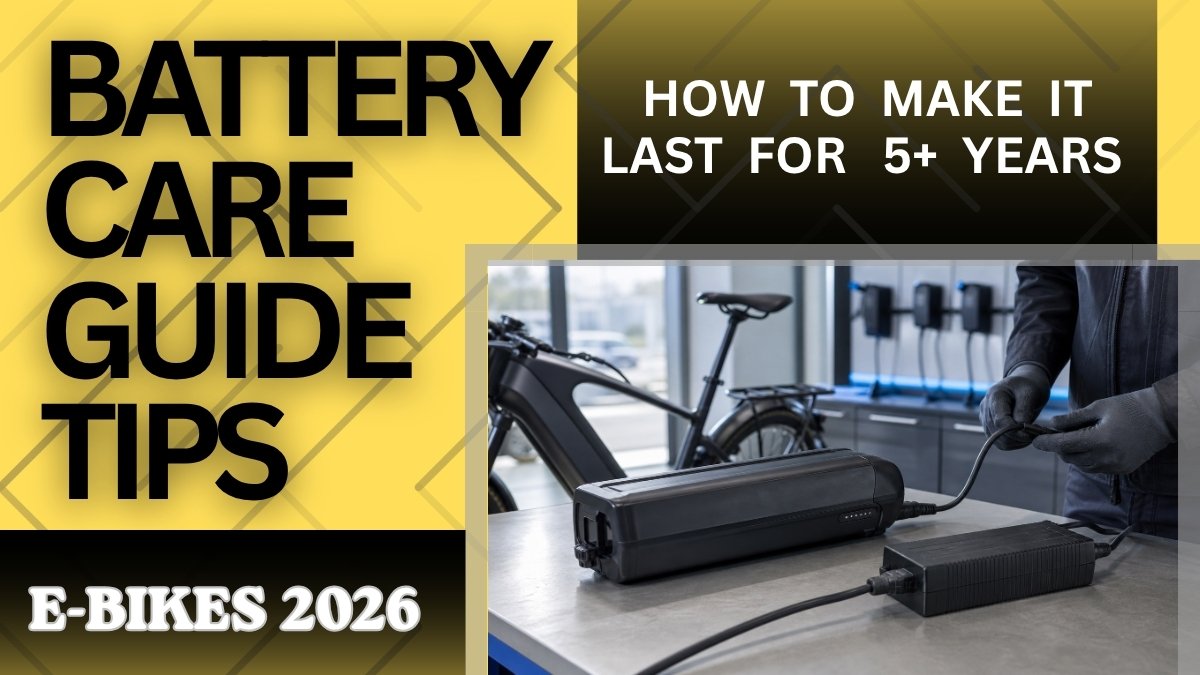
The lithium-ion battery is the single most expensive component on an electric bike, often accounting for a third or more of its total value. While every rechargeable battery naturally degrades over time, how you charge, store, and ride with your battery directly determines whether it lasts two years or seven years.
Most modern e-bikes utilize lithium-ion (Li-ion) chemistry—specifically variants like Lithium Nickel Manganese Cobalt Oxide (NMC) or Lithium Iron Phosphate (LiFePO4). Understanding how to care for these chemical cells prevents premature capacity loss, saves hundreds of dollars in replacement costs, and ensures maximum reliability on every ride.
1. Battery Lifespan Key Rules
| Care Factor | Optimal Range / Best Practice | Action to Avoid |
|---|---|---|
| Daily Charge Level | Keep between 20% and 80% for regular rides | Avoid leaving at 100% or draining to 0% continuously |
| Storage Temperature | 50°F to 70°F (10°C to 20°C) in a dry place | Avoid leaving in freezing garages or hot car trunks |
| Long-Term Storage Charge | Store at 40% to 60% capacity | Avoid storing fully charged or completely empty |
| Charging Behavior | Charge at room temperature using factory chargers | Avoid charging immediately after heavy, hot rides |
2. Charging Best Practices and Voltage Management
Master the Golden Rule: The 20% to 80% Charge Zone
Lithium-ion cells experience the highest amount of internal chemical stress when they are completely full (100%) or completely empty (0%).
Avoid Keeping It at 100% Constantly
Charging your battery to 100% every single night—especially if you only use 10% of the charge the next day—accelerates capacity degradation. If you do not need maximum range for your upcoming ride, top off the battery to around 80% or 90%.
Charge to 100% Just Before Riding
When you do need maximum range for a long journey, charge the battery to 100%, but try to ride shortly after. Leaving a battery sitting at 100% state-of-charge for days or weeks at a time degrades the internal cathode materials.
Never Leave It at 0%
Leaving a battery completely drained can trigger the Battery Management System (BMS) to enter a deep sleep mode, or cause the voltage to drop below a safe threshold. Once cells drop below critical voltage, the battery may permanently lock out and become unchargeable.
Manage Charging Temperatures and Thermal Shock
Temperature plays a vital role in battery health. Charging a battery when its internal temperature is too cold or too hot causes permanent physical damage to the cell anodes through a process known as lithium plating.
Never Charge Below Freezing (32∘F/0∘C)
Attempting to charge a lithium-ion battery in sub-freezing temperatures causes metallic lithium to deposit on the anode, creating internal short circuits and permanently destroying capacity. If you ride in winter, bring the battery indoors and allow it to warm up to room temperature for at least an hour before plugging it into the charger.
Let the Battery Cool After Riding
Hard riding on high pedal-assist or steep hills heats up the internal cells. Always wait 15 to 30 minutes after a ride to let the battery cool down to ambient room temperature before connecting the charger.
Charge in a Cool, Dry Location
Charge your battery on a non-flammable surface in a climate-controlled room (ideally between 50°F and 70°F). Avoid charging in direct sunlight or in unventilated storage sheds during summer months.
3. Proper Long-Term Storage Protocol
If you plan to store your e-bike for several weeks or over the winter season, preparing the battery correctly is critical to preserving its health.
The Ideal Storage State (40% to 60%)
Never store a battery long-term at 100% or near 0%. The sweet spot for long-term storage is around 40% to 60% charge (typically 3 out of 5 indicator lights). At this voltage level, the internal chemical structure remains completely stable.
Remove from the Bike
Store the battery detached from the e-bike in a dry, temperature-regulated room.
Perform Monthly Check-Ins
Even when off, the internal Battery Management System (BMS) draws a tiny amount of power (self-discharge). Check the battery level once every month during seasonal storage. If it drops below 30%, charge it back up to 50%.
4. Hardware Safety and Physical Protection
Always Use the Original, Manufacturer-Approved Charger
Using cheap, aftermarket, or unapproved third-party chargers is one of the leading causes of battery degradation and thermal runaway fires.
Voltage and Amperage Matching
E-bike chargers are precisely calibrated to match the voltage curves and target current of the specific BMS inside your battery pack. Third-party chargers may deliver incorrect voltage cut-offs or excessive amperage, cooking internal cells.
Fast Chargers vs. Standard Chargers
While high-output “fast chargers” (4A–6A) are convenient, they generate significantly more internal heat than standard 2A chargers. Use standard chargers for daily charging, and reserve fast chargers only for mid-ride top-offs when traveling long distances.
Protect the Battery from Physical Impact and Water Ingress
Lithium battery packs are enclosed in durable plastic or aluminum housings, but physical shock and water exposure can bypass seals and damage internal circuits.
Avoid Submersion and High-Pressure Washing
While most batteries carry an IP rating (such as IP65) that protects against light rain and splashes, never submerge your battery or use a high-pressure power washer on your bike. Water forcing its way past rubber gaskets will corrode the terminal connections and short out the BMS board.
Inspect Frame Mounts
Ensure the battery latches firmly into its frame dock without rattling. Loose battery fitment creates vibrational stress on electrical pins during rough trail or street riding, leading to intermittent power cuts and arc damage on terminal contacts.
Conclusion: Summary Checklist for Maximum Lifespan
By adopting these daily habits, you can comfortably achieve 500 to 1,000 full charge cycles (which translates to 3 to 7 years of regular riding) before noticing significant capacity drop-offs:
- Keep daily charge levels between 20% and 80%.
- Never plug in a charger when the battery is freezing cold or hot from a ride.
- Use only the original factory charger supplied with the bike.
- Store the battery indoors at 40%–60% charge over the winter.
- Keep terminal pins clean and protected from direct high-pressure water.
Taking proactive care of your e-bike battery preserves its range, keeps your rides reliable, and ensures you get the absolute maximum return on your investment over years of commuting and trail riding.