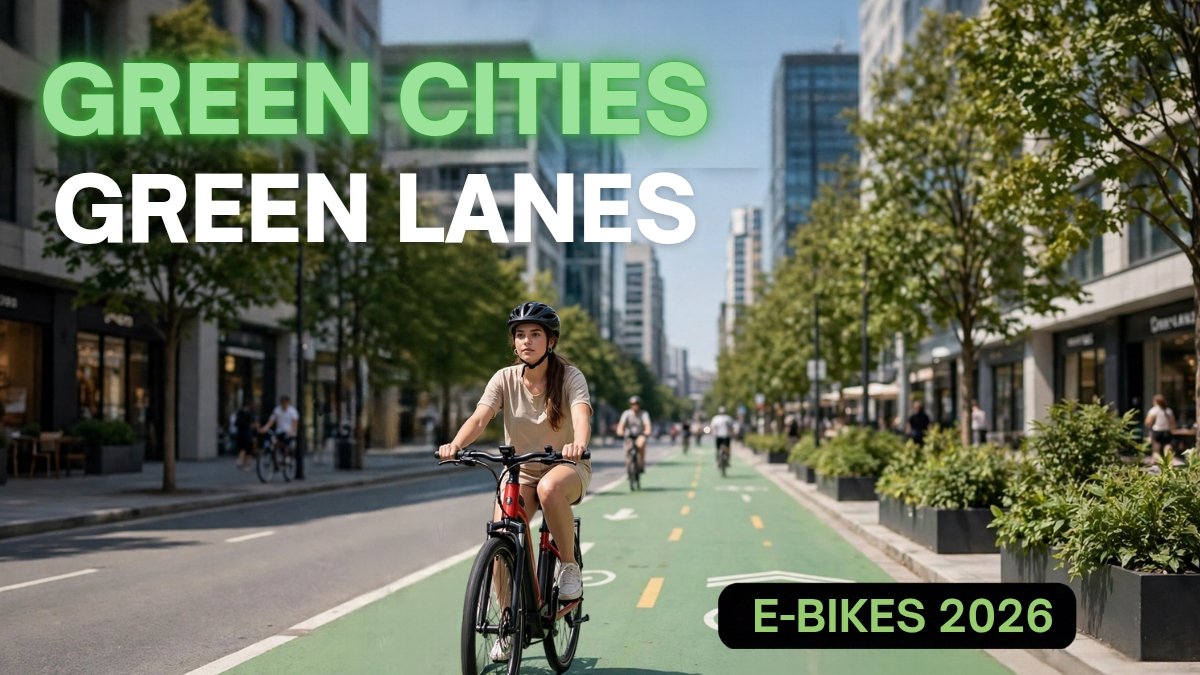
If you ride an e-bike in a big city, you already know the problem. The roads were made for cars, not for e-bikes.
E-bikes are faster than normal cycles and heavier too. But they are still much smaller than cars. When you put a fast e-bike in the same narrow lane with cars and buses, it becomes dangerous.
That is why cities around the world are now changing their roads specially for e-bikes. Wider lanes, strong barriers, smart charging, and better parking near train and bus stations.
In this article, I will explain in simple words how cities are redesigning for the e-bike revolution, and what it means for you as a rider.
Quick Comparison: Old City Roads vs New E-Bike Roads
| Feature | Old City Design | New E-Bike Friendly Design |
| Bike Lane Width | 4 to 5 feet, only for one cycle | 8 to 10 feet, enough for overtaking and cargo bikes |
| Separation | Only white paint line or plastic stick | Concrete curb, raised median, planter boxes |
| Intersection | Same signal as cars, blind spot | Separate e-bike signal, early green for bikes |
| Charging | No charging on road | Smart charging lockers near stations and markets |
| Parking | Open stand, no security | Indoor secure parking with CCTV and fire safety |
| Road Surface | Thin asphalt, breaks quickly | Strong concrete base for heavy cargo bikes |
In simple words: Old roads just gave you paint. New roads give you protection.
1. No More Only Paint Lines – Now Concrete Protection
This is the biggest change in 2026.
Old bike lanes were just a white line on the road. A car could easily cross it, park on it, or open a door on you. This was the main cause of accidents.
New cities are removing paint-only lanes on busy roads and replacing them with:
Concrete Curbs and Raised Medians
A solid concrete barrier between cars and e-bikes. A car cannot enter your lane by mistake.
Planter Boxes
Big concrete planters with plants act as a barrier and also make the road look better.
Separate Express Lanes for Fast E-Bikes
In big corridors, there are now two types of lanes. A slow lane for normal cycles and walkers, and a wide smooth express lane for fast e-bikes and cargo bikes. This way fast riders do not disturb slow riders.
Cycle Superhighways
Some cities are building long cycle highways from suburbs to city centre, completely separate from car roads. Some are even elevated. You can ride 10 to 15 km without stopping in traffic.
Why does this matter for you? Because e-bikes go 25 to 45 km/h. At this speed, a small mistake by a car driver can be very dangerous. Concrete protection saves lives.
2. Safer Crossings and New Traffic Signals
Most accidents do not happen on straight roads. They happen at crossings and turns.
Cities are now fixing crossings in 3 ways:
Dutch-Style Protected Corners
At the turn, a small corner island is made. This forces the car to slow down and turn at a 90-degree angle. The driver can clearly see the e-bike rider before turning. No blind spot.
Early Green Signal for E-Bikes
E-bikes get green light 3 to 5 seconds before cars. This gives riders time to cross the junction safely before cars start moving.
Smart Sensors
Road sensors and cameras can detect a group of e-bikes coming. The system automatically keeps the green light on a little longer during rush hours, so riders do not get stuck in the middle of the crossing.
If your city has started this, you will feel the difference in your daily ride immediately.
3. Charging and Battery Swap On The Road
Range anxiety is still a big problem. What if battery ends in the middle of the city?
Cities are solving this with micro-utility grids:
On-Street Smart Charging Lockers
Near metro stations, offices, and markets, there are now weather-proof charging lockers. You lock your battery or full bike inside, charge it while you work, and take it back full.
Battery Swap Stations for Delivery Riders
Delivery companies are now using e-cargo bikes instead of vans. For them, cities have given small curb-side hubs where a rider can swap an empty battery with a full one in less than 1 minute. No waiting for charging.
Solar Charging Docks
Bike-share stations are now connected to the city power grid with solar roofs on top. They charge bikes with solar power and balance the load so the local transformer does not get overloaded.
This is very useful for people who live in flats and cannot charge at home.
4. E-Bike + Train / Bus Connection
An e-bike alone cannot take you 30 km every day. But e-bike + train can.
That is why cities are making transit integration easy:
Easy Entry in Trains
New trains have wider doors, flat floors, and tie-downs to hold heavy e-bikes safely. You do not need to lift the bike.
Secure Multi-Storey Parking Hubs
Big stations now have indoor parking only for e-bikes. You enter with a card, CCTV is on 24 hours, and there is special fire safety for lithium batteries. This is much safer than parking outside.
One App for Everything
With one MaaS (Mobility-as-a-Service) app, you can unlock a shared e-bike, book a train ticket, and open secure parking. One account, one payment.
If your city has this, you can leave your car at home.
5. Stronger Roads For Heavy Cargo Bikes
Normal cycles weigh 12 to 15 kg. E-cargo bikes with load can weigh more than 180 kg. Old roads were not made for this weight.
New design includes:
Wider Turns
Sharp 90-degree turns are replaced with wide sweeping turns. Long cargo bikes can turn without going into the walking path.
Stronger Road Base
Roads are now made with reinforced concrete base instead of thin asphalt. This stops cracks and holes from heavy daily use.
Flat Curb Ramps
No high jumps between road and footpath. Smooth flat ramps prevent wheel damage and tipping when the bike is fully loaded.
This is important not only for delivery riders, but also for families who carry kids on e-bikes.
6. Smart Roads: Bikes Talking To Cars
This sounds like future, but it has already started in some cities.
V2X Safety Alerts
Small transmitters on e-bikes send signals to nearby cars and traffic lights. If an e-bike is coming from a blind turn, the car driver gets a warning inside the car.
Auto Speed Control in Crowded Areas
With GPS geofencing, shared e-bikes automatically slow down in parks, school zones, and markets. No need for police to check manually.
Data for Better Roads
Anonymous GPS data from shared bikes tells the city where traffic is high, where road is broken, and where new lanes are needed. So the city spends money in the right place.
7. New Rules and Subsidies
Good roads alone are not enough. Clear rules are also needed.
Class System
Cities are now clearly defining Class 1, Class 2, and Class 3 e-bikes. High-speed Class 3 bikes are allowed only on express cycle tracks, not on walking paths.
Subsidies and Vouchers
Many cities now give money back, tax rebate, or point-of-sale voucher when you buy an e-bike. Extra subsidy is given for cargo e-bikes because they replace delivery vans.
Low-Emission Zones (LEZ)
In city centres, petrol delivery vans are not allowed during peak hours. Companies are forced to use e-cargo bikes. This reduces pollution and traffic.
Pros and Cons of This New City Design
Pros
- Much safer riding with concrete protection
- Faster commute, less traffic jam
- Easy charging and secure parking
- Cleaner air and less noise
- Delivery becomes cheaper and faster
Cons
- Building new lanes takes time and money
- In some old cities, roads are too narrow to make wide lanes
- New smart systems need maintenance
- Some car drivers complain about less space for cars
But overall, for e-bike riders, this change is very positive.
Frequently Asked Questions (FAQs)
How will cities change for e-bikes in the future?
Cities are building wider, separate, concrete-protected lanes only for e-bikes. They are also adding smart charging near stations and secure parking. In the next few years, riding an e-bike in the city will be much safer than sharing the main road with cars.
Are dedicated e-bike lanes really necessary?
Yes. E-bikes are faster than normal cycles and slower than cars. If they share the same lane with cars, it is dangerous. A separate lane with concrete barrier reduces accidents and makes more people confident to ride daily.
Will this urban redesign make e-bikes faster in the city?
Yes. With separate lanes and early green signals, you do not get stuck behind cars. In many cities, a 40-minute car trip in traffic now takes only 25 minutes on an e-bike using the new connected network.
Can I take my e-bike in the train or metro?
In most new e-bike friendly cities, yes. Trains now have wider doors and dedicated space for e-bikes. At big stations, you can also park your e-bike in a secure indoor hub and take the train.
Do I need a different e-bike for city and highway?
No. For city use, a normal city e-bike with 700Wh battery and good brakes is enough. You do not need a high-speed off-road model unless you ride on hills or rough roads daily.
Final Verdict
Cities are no longer asking “should we make space for e-bikes?” They are now asking “how fast can we make it?”
From concrete lanes to smart charging to train connection, the whole city design is shifting from car-first to people-first.
If you live in a city that is starting this change, this is the best time to buy an e-bike. You will save time, save petrol money, and ride much safer than before.
2 thoughts on “How Cities Are Changing For E-Bikes: New Roads, Lanes, and Smart Charging in 2026”