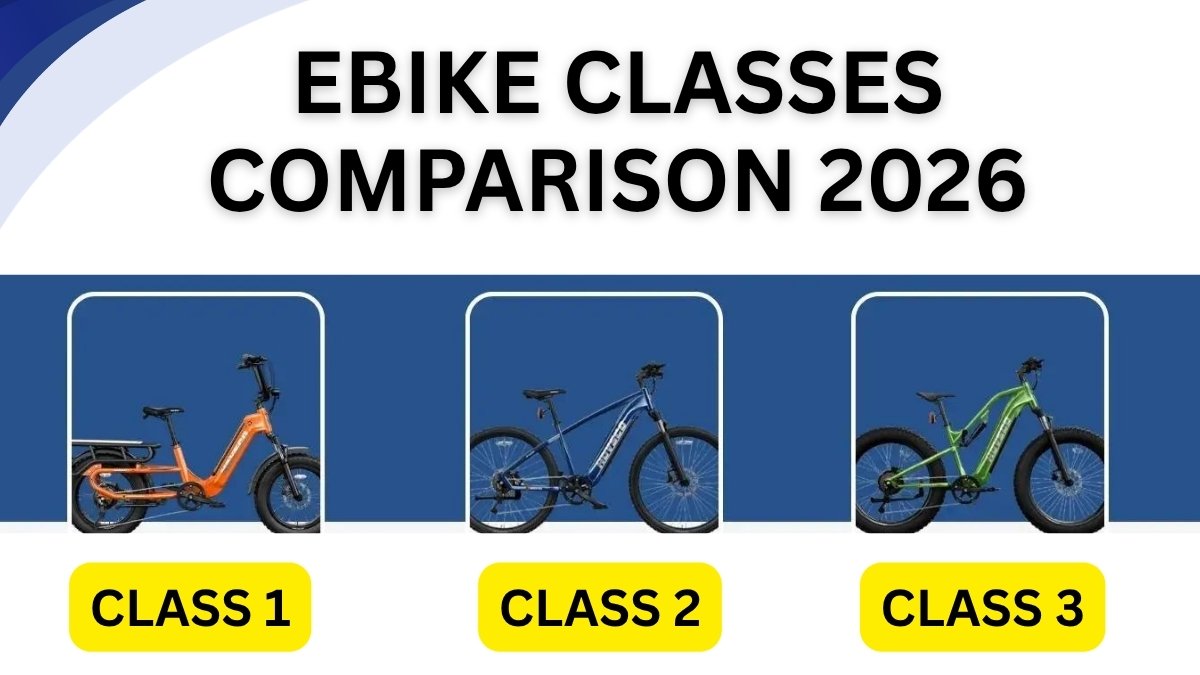
As electric bicycles (e-bikes) continue to grow in popularity worldwide, regulatory agencies and manufacturers have established a unified classification system to standardize speed limits, motor operations, and road permissions. In the United States and many international jurisdictions, e-bikes are divided into three distinct categories: Class 1, Class 2, and Class 3.
Understanding these classes is critical before purchasing an e-bike. The class determines how fast the bike can assist you, whether it features a throttle, where you are legally allowed to ride, and whether age or helmet restrictions apply in your region. This guide breaks down the technical, legal, and functional differences across all three e-bike classes.
1. Summary Comparison Matrix
| Feature | Class 1 E-Bike | Class 2 E-Bike | Class 3 E-Bike |
| Pedal Assist (PAS) | Yes (Required) | Yes | Yes (Required) |
| Throttle Function | No | Yes (Required) | No (Usually) |
| Top Assisted Speed | 20 mph (32 km/h) | 20 mph (32 km/h) | 28 mph (45 km/h) |
| Max Motor Power | 750 Watts | 750 Watts | 750 Watts |
| Multi-Use Trail Access | High (Allowed on most trails) | Moderate (Varies by location) | Low (Restricted to roads/bike lanes) |
| Typical Use Case | Commuting, MTB, casual riding | Relaxed cruising, urban errands | Fast long-distance commuting |
2. Class 1 E-Bikes: Pedal-Assist Only (20 mph Top Speed)
How Class 1 Works
A Class 1 electric bicycle relies entirely on pedal assistance (PAS). This means the electric motor provides power only when the rider actively turns the pedals. The moment you stop pedaling, or as soon as the bike reaches 20 mph (32 km/h), the motor automatically cuts off electrical power assistance. You can ride faster than 20 mph, but any additional speed relies strictly on human pedaling effort or gravity going downhill.
Key Features & Advantages
No Throttle
There is no twist-throttle or thumb-button to propel the bike without pedaling.
Broad Access Rights
Because Class 1 e-bikes behave most similarly to traditional non-electric bicycles, they enjoy the broadest legal access. They are generally permitted on multi-use paved paths, urban bike lanes, and many mountain biking trails.
Intuitive Riding Experience
Power delivery feels natural because the motor amplifies your pedaling input seamlessly via cadence or torque sensors.
Best Suited For
Class 1 bikes are ideal for mountain bikers, fitness-oriented riders, and urban commuters who want to maintain an active pedaling motion while getting a smooth boost on hills and head winds.
3. Class 2 E-Bikes: Throttle-Assisted (20 mph Top Speed)
How Class 2 Works
A Class 2 e-bike introduces a throttle system in addition to pedal assistance. The throttle is typically built into the handlebars as a thumb press or twist grip. Engaging the throttle allows the motor to propel the bicycle forward completely independently—without requiring the rider to turn the pedals at all.
Key Features & Advantages
Throttle Propulsion
You can cruise effortlessly at speeds up to 20 mph (32 km/h) solely on motor power.
Pedal Assist Integration
Class 2 bikes also feature pedal assist levels, allowing you to choose between human effort, motor effort, or a combination of both.
Easy Acceleration from Full Stops
The throttle provides immediate acceleration from red lights, stop signs, or heavy traffic situations, eliminating the friction of starting a heavy frame from a standstill.
Access Restrictions & Best Uses
Because Class 2 e-bikes can move under motor power alone, some nature trails, mountain bike paths, and non-motorized multi-use paths restrict their use. However, they remain widely legal on public streets, designated bike lanes, and standard paved paths. Class 2 bikes are optimal for casual cruisers, cargo transport, riders with physical joint limitations, and commuters who want to avoid sweating on their way to work.
4. Class 3 E-Bikes: Speed Pedal-Assist (28 mph Top Speed)
How Class 3 Works
Class 3 e-bikes—often referred to as “speed pedelecs”—are designed for higher-speed transportation. Like Class 1 bikes, a Class 3 e-bike provides motor assistance only when you pedal. However, the motor assistance continues up until the bike reaches a top speed of 28 mph (45 km/h) before cutting off.
Key Features & Regulations
Higher Speed Cap
The 28 mph motor cutout allows riders to easily keep pace with urban motor vehicle traffic, significantly shortening long-distance commute times.
Speedometer Requirement
Most regional regulations mandate that Class 3 e-bikes come equipped with a built-in speedometer to help riders track their speed in shared zones.
Throttle Nuance
Standard Class 3 definitions ban throttles. However, some regions allow “Class 3 combo” bikes that feature a throttle capping out at 20 mph, while pedal assist pushes up to 28 mph.
Rider & Path Restrictions
Due to higher operation speeds, Class 3 e-bikes are prohibited on most traditional multi-use paths, pedestrian walkways, and dirt mountain bike trails. They are primarily intended for roadways, shoulder lanes, and protected urban bike lanes. Some states also enforce minimum age limits (typically 16+) and mandatory helmet laws for Class 3 riders regardless of age.
Best Suited For
Class 3 e-bikes are built for high-speed commuters replacing cars or public transit on long stretches of pavement, arterial roads, and highway bike corridors.
Conclusion: Key Factors to Consider Before Buying
To choose the right e-bike class for your needs, evaluate the following practical considerations:
- Local Laws & Trail Access: Always check local municipal, state, or park regulations before buying. If your primary goal is riding unpaved single-track trails or national park paths, a Class 1 e-bike is often the only legally permitted option.
- Commuting Distance & Traffic Conditions: If your commute involves riding alongside fast-moving urban traffic over distances greater than 10 miles, a Class 3 e-bike offers time savings and safety through speed matching. For short city trips with frequent stops, a Class 2 throttle bike provides excellent convenience.
- Battery Consumption: Higher speeds require exponentially more energy. Riding a Class 3 e-bike at a sustained 28 mph consumes battery power significantly faster than riding a Class 1 bike at 15 to 20 mph. If you select a Class 3 model, ensure it features a battery capacity of 600Wh or higher to maintain reasonable range.